


If your roof took a hailstorm this week, here’s the verdict: stay off it, walk your yard for evidence, photograph everything, and call an inspector within 30 days if you spot dents on metal or granules pooling in your gutters. That single window matters more than most homeowners realize. Insurers scrutinize timing, and evidence fades fast once wind and rain move through again.
Start with what you can see from solid ground. Walk the perimeter of your house and check your gutters, downspouts, air conditioning fins, and any metal vents or flashing for small dents. Look at your car, your mailbox, and your deck rails. If they took a beating, your shingles probably did too.
- Photograph dents on vents, gutters, and siding, plus granules collected in downspouts.
- Save a screenshot of the storm date and hail size from a local weather report.
- Note whether your roof is older than 15 years, since aging shingles show hail stress more severely.
Pro Tip: A ten-year granule-loss study found that granule loss alone rarely shortens shingle life unless the underlying asphalt mat is exposed. Don’t panic over cosmetic marks. Look for actual punctures, bruising, or soft spots instead.
Key Takeaways
Hail damage claims succeed when homeowners document functional damage quickly, distinguish it from cosmetic wear, and get a professional inspection before filing.
| Point | Details |
|---|---|
| Act within 30 days | Document damage and contact an inspector promptly, since evidence fades and insurers expect prompt notice. |
| Know the damage type | Functional damage (punctures, cracks) supports a claim; cosmetic-only marks often get denied. |
| Use the 10% threshold | Sampling-based inspections generally recommend replacement once functional damage nears or exceeds 10% of the roof. |
| Watch for storm chasers | Avoid contingency-only contracts and large upfront deposits from crews with no local presence. |
| Choose a local pro | Crowley Exteriors offers free inspections, documented claim support, and a 25-year workmanship guarantee across St. Charles County. |
Table of Contents
- What Does Hail Damage Look Like on Different Roofing Materials?
- How Do You Safely Check a Roof for Hail Damage?
- Who Should You Call First: Roofer, Adjuster, or Independent Inspector?
- When Should You File a Hail Damage Insurance Claim?
- Should You Repair or Replace a Hail-Damaged Roof?
- What Do Hail Damage Inspections and Repairs Typically Cost?
- Which Roofing Upgrades Reduce Future Hail Damage?
- How Can You Spot a Storm-Chaser Roofing Scam?
- Why Local Experience Matters for Hail Damage Repairs
- A Six-Step Checklist for Homeowners After a Hailstorm
- How Crowley Exteriors Handles a Hail Damage Inspection
- Frequently Asked Questions About Hail Damage Roofs
- Sources
What Does Hail Damage Look Like on Different Roofing Materials?
Hail doesn’t hit every roof the same way, and the material underneath changes what you’re looking for. Asphalt shingles show the classic signs: circular patches of missing granules, soft or slightly indented spots you can feel with your palm, and dark bruises where the mat has been compressed but not torn. In more severe hits, you’ll see shiny black asphalt exposed where granules were knocked completely clear, a sign the shingle’s protective layer is gone in that spot.
Metal roofing tells a different story. Hail leaves round dents rather than granule loss, and while dents rarely cause leaks, they can void certain warranties and signal that a bigger stone caused a hairline crack somewhere less visible. Clay and concrete tile crack or split outright rather than bruise, often along a clean line. Wood shakes fracture or splinter, sometimes shedding small wood chips you’ll find in the gutter alongside granules.
- Asphalt shingles: circular granule loss, bruising, soft spots, exposed shiny asphalt.
- Metal: round dents concentrated on the storm-facing slope.
- Tile: cracked or split pieces, often near the edges or ridge caps.
- Wood shakes: splits, fractures, and shed splinters in gutters.
Hail size and wind direction shape where the worst damage lands. A storm with strong horizontal wind concentrates impacts on one or two slopes, while a straight-down hailstorm spreads damage more evenly across the whole roof. Travelers’ guidance on identifying hail damage notes that dents on metal components like gutters and vent caps often show up before shingle damage is visible from the ground, which makes them a useful early flag. Steeper roof slopes generally take less direct impact than low-slope sections, since hail glances off at an angle rather than striking flat.
How Do You Safely Check a Roof for Hail Damage?
You don’t need to climb a ladder to build a solid case. Most of the useful evidence is visible from the ground, and a lot of homeowners cause more damage falling off a wet roof than the hailstorm did in the first place.
- Walk the ground perimeter first. Check gutters for granules, AC fins for dents, and any parked vehicles or outdoor furniture for pockmarks. Inspectapedia’s field guide points out that correlating these ground-level clues with your roof’s storm-facing side helps confirm the damage timeline.
- Photograph everything, twice. Take wide shots showing context (the whole slope, the gutter line) and close-ups of individual dents or bruises. Shoot from multiple angles so nothing reads as a shadow or a trick of light.
- Save your weather proof. A local NWS storm report or news coverage of the hail event, saved with a timestamp, backs up your claim that the damage is recent and storm-related.
- Call a professional when access is limited or damage is ambiguous. A drone inspection or a HAAG-certified inspector can document steep slopes or multi-story roofs you shouldn’t be walking, and their reports carry more weight with adjusters than a homeowner’s cell phone photos alone.
Pro Tip: Keep a folder, digital or physical, with every photo dated and labeled by roof section. Adjusters move faster when your evidence is already organized instead of scattered across a phone’s camera roll.
Who Should You Call First: Roofer, Adjuster, or Independent Inspector?
The right professional depends on where you are in the process. A free contractor inspection is the fastest way to get eyes on your roof, but remember the contractor has an incentive to find damage worth repairing, so treat that first look as a screening tool rather than a final verdict.
- Roofing contractor (free inspection): quick, no-cost screen for obvious damage; useful as your first call.
- Independent or HAAG-certified inspector: the most credible option when the scope of damage is disputed or your insurer’s adjuster and your contractor disagree significantly.
- Public adjuster: hired to negotiate your claim on your behalf, typically for a percentage of the payout, best reserved for complex or contested claims.
- Second opinion triggers: a denied claim, visible structural concerns like sagging decking, or a wide gap between your contractor’s estimate and the insurance adjuster’s assessment.
Independent inspection reports typically run somewhere in the range of a paid service call, and what you get back is a documented, third-party assessment rather than a sales estimate, which matters if your claim ends up in dispute.
When Should You File a Hail Damage Insurance Claim?
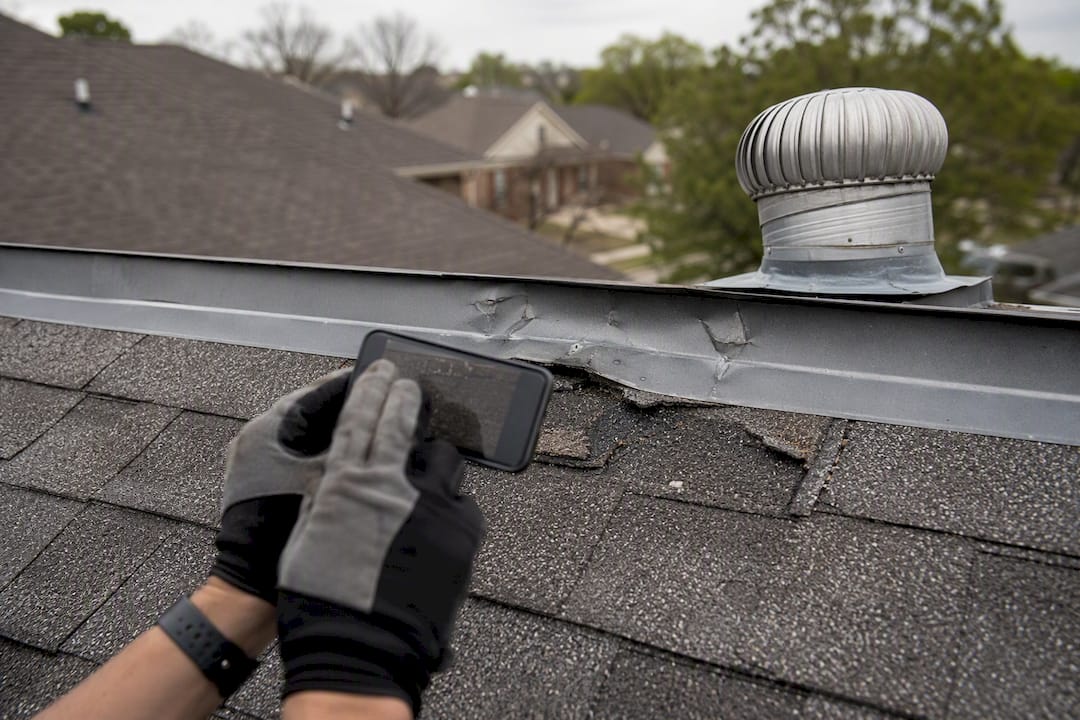
Timing drives almost everything here. Most policies require prompt notice after a loss, and the clock effectively starts on the date of the storm, not the date you happen to notice a leak weeks later. Filing quickly, with photos and a weather report in hand, gives the claim a much stronger foundation than a vague “sometime last month” description.
Insurers draw a hard line between functional damage and cosmetic damage, and this distinction decides more claims than any other single factor. Functional damage means the hail actually compromised how the roof performs. Punctures, fractures, and exposed mat that could let water in. Cosmetic damage is surface bruising or granule loss that doesn’t affect the roof’s ability to shed water. Many adjusters will deny claims that only show cosmetic wear, and some policies explicitly exclude cosmetic-only hail coverage for metal roofs.
- Document the storm date immediately using a local NOAA or NWS report.
- Distinguish functional damage (punctures, cracks, exposed mat) from cosmetic marks in your photos and notes.
- Expect your roof’s age and prior wear to factor into the adjuster’s assessment, since older roofs already show granule thinning unrelated to hail.
- Know your policy type: actual cash value (ACV) pays depreciated value, while replacement cost value (RCV) pays to replace at current prices, often with a holdback released after work is completed.
Filing generally makes sense when repair or replacement costs clearly exceed your deductible and the damage is functional, not just cosmetic. Most standard homeowners policies cover hail as a named peril, but payout amount depends heavily on your deductible size, your roof’s age, and whether you carry ACV or RCV coverage. Meeting the adjuster with your own photo log and a contractor’s written estimate in hand tends to produce a faster, more accurate settlement than waiting to see what they find on their own.
Should You Repair or Replace a Hail-Damaged Roof?
The honest answer is that it depends on how much of the roof took a hit, not just how bad any single shingle looks. Forensic evaluators use a sampling method: they mark out sample areas on each roof slope, count impact marks per square, and calculate a percent-damaged figure for the whole roof. Nelson Forensics’ guideline treats roughly 10% functional damage as a rough threshold. Below that, spot repairs usually make sense. Above it, full replacement tends to be more practical than patchwork.
Three factors push the decision toward replacement even when the percentage is borderline:
- Roof age. A 20-year-old roof with 8% damage is a different conversation than a 3-year-old roof with the same percentage, since the older roof is closer to the end of its service life anyway.
- Matching difficulty. Discontinued shingle colors or profiles make spot repairs look patched and can lower resale value even when they’re structurally sound.
- Number of affected slopes. Damage spread across three or four slopes usually costs more to patch piecemeal than to reroof outright once labor and material setup are factored in.
| Damage Scenario | Typical Recommendation |
|---|---|
| Under 10% functional damage, single slope | Spot or partial-slope repair |
| 10 to 25% functional damage, multiple slopes | Full-slope repair or partial replacement |
| Over 25% functional damage, or roof past midlife | Full replacement recommended |
Crowley Exteriors builds every estimate around this kind of sampling logic rather than a flat “replace everything” recommendation, so homeowners see exactly why a slope needs repair versus a full tear-off.
What Do Hail Damage Inspections and Repairs Typically Cost?
Costs scale with how much of the roof is affected, and the range is wide enough that a single quote in isolation doesn’t tell you much. A contractor’s initial inspection is usually free, while an independent or drone-assisted inspection for a contested claim runs higher but delivers a more defensible report.
- Inspection: free for a standard contractor screen; paid independent or drone inspections cost more but carry more weight in a dispute.
- Spot repairs: generally the least expensive option, suited to isolated damage on one section.
- Partial-slope repairs: a mid-range cost for damage concentrated on one roof face.
- Full-slope or full replacement: the highest cost tier, but often the better value once damage spreads across multiple slopes.
Your deductible sets your real out-of-pocket number regardless of the total repair bill, and roof complexity (steep pitches, multiple valleys, dormers) adds labor cost on top of materials. If your policy pays ACV rather than RCV, expect a depreciation deduction that you may only recover once the work is actually completed.
Which Roofing Upgrades Reduce Future Hail Damage?
If you’re replacing anyway, this is the moment to upgrade rather than rebuild what just failed. Impact-resistant shingles rated Class 4 under UL 2218 testing hold up significantly better against hail impact than standard three-tab or architectural shingles, and many insurers offer a premium discount for installing them, sometimes enough to offset the higher material cost over a few years.
Metal roofing and synthetic slate go a step further for homeowners who want a longer-term answer. Both resist hail bruising almost entirely compared to asphalt, though metal carries a higher upfront cost and synthetic slate sits in between on price and lifespan.
- Class 4 impact-resistant shingles: better hail resistance, often paired with an insurance discount.
- Metal roofing: minimal hail damage risk, higher upfront cost, decades-long lifespan.
- Synthetic slate: strong hail resistance with a lighter weight than natural slate.
- Routine inspection cadence: an annual check catches wear before it becomes a denied claim tied to “pre-existing deterioration.”
How Can You Spot a Storm-Chaser Roofing Scam?
Every hailstorm brings out-of-state crews knocking on doors within days, and some of them do solid work. Plenty don’t. Watch for high-pressure pitches, contracts that only pay the contractor if your insurance claim gets approved, and demands for a large deposit before any work starts.
Inspectors trained to spot fraud look for non-random damage patterns and crushed granule powder, signs that damage was staged with a hammer rather than caused by falling ice. Real hail hits are scattered and irregular, not clustered in a suspiciously even grid.
- Ask for local references and a physical business address, not just a truck with out-of-state plates.
- Verify contractor insurance and licensing before signing anything.
- Get at least two independent, documented estimates before committing to repairs.
Pro Tip: If a contractor pressures you to sign before your insurance adjuster has even visited, that’s a red flag worth walking away from.
Why Local Experience Matters for Hail Damage Repairs
Crowley Exteriors has spent more than 25 years working on roofs across St. Charles County, which means the crew has seen how Missouri hailstorms behave on this region’s roof pitches and materials specifically, not just in general.
- Every inspection is free with a no-obligation, written estimate, so you know your options before spending anything.
- Damage gets documented with dated photos and notes formatted to support an insurance claim, not just a sales pitch.
- Roofing work carries a 25-year workmanship guarantee, backing up the repair or replacement long after the crew leaves.
- The team has coordinated directly with insurance adjusters on storm claims across the county for years.
A Six-Step Checklist for Homeowners After a Hailstorm
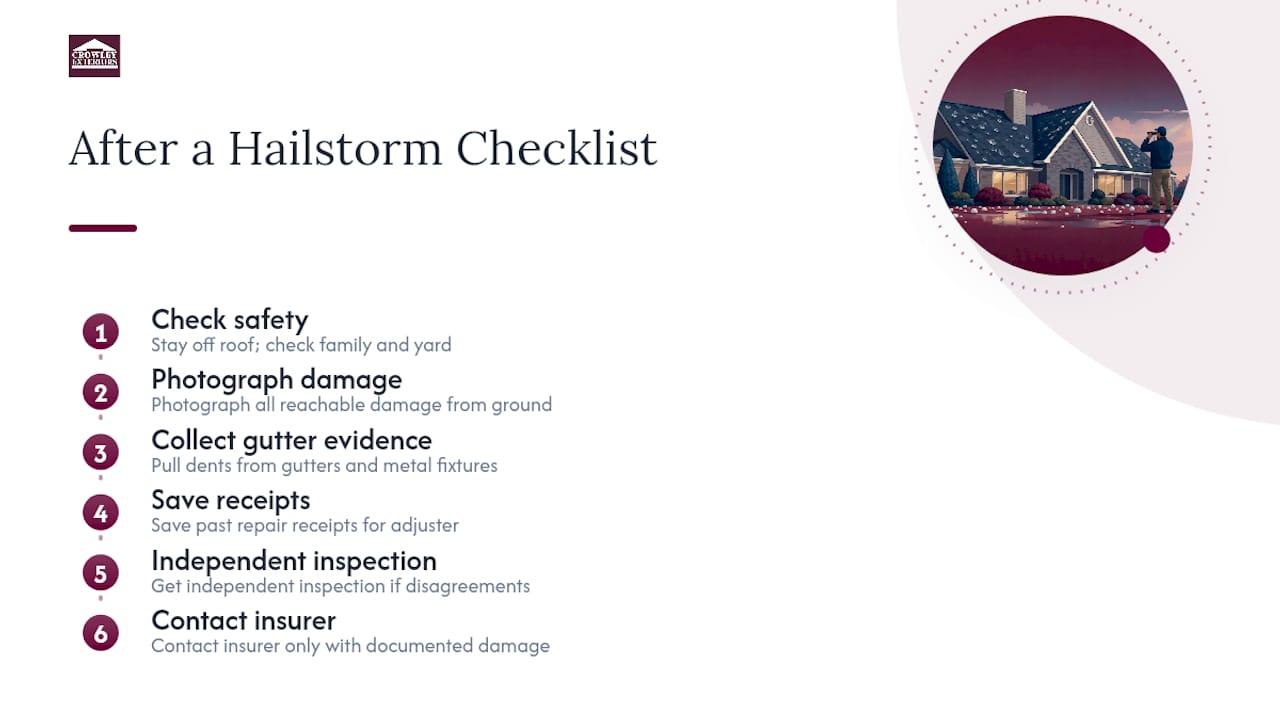
Here’s the order that actually matters. First, stay off the roof and check yourself, your family, and your yard for immediate safety issues. Second, photograph every sign of damage you can reach from the ground. Third, pull evidence from your gutters and any metal fixtures, since those dent before shingles show obvious wear. Fourth, save any repair receipts from the past few years in case an adjuster questions pre-existing wear. Fifth, get an independent inspection if your contractor and your insurer disagree. Sixth, contact your insurer only once you have documented, functional damage in hand, not before.
How Crowley Exteriors Handles a Hail Damage Inspection
There are other ways to handle a hail claim. You can call a national chain, hire a public adjuster outright, or try to document everything yourself and negotiate solo. Crowley Exteriors offers a more direct path: a free, no-obligation inspection from a crew that has worked St. Charles County roofs for over 25 years and knows exactly what local adjusters expect to see.

The process is straightforward. A Crowley Exteriors inspector walks your roof, photographs every impact point by slope, and hands you a written estimate you can bring to your insurance adjuster instead of guessing what to say. Every job is backed by a 25-year workmanship guarantee, so the repair or roof replacement you approve today is covered well past the next storm season. If your gutters took the same hit as your shingles, the team handles that under one visit through its gutter services rather than sending you to a second contractor. Schedule a free inspection this week while the storm date is still fresh enough to document clearly.
Frequently Asked Questions About Hail Damage Roofs
What does hail damage look like on shingles?
Look for circular patches of missing granules, soft indented spots, dark bruising, and occasionally shiny exposed asphalt where the granule layer is completely gone.
How do I check my roof for hail damage without climbing up?
Check gutters for granules, inspect AC fins and metal vents for dents, and look at your car or outdoor furniture for pockmarks, then photograph everything from the ground.
What’s the difference between hail damage and blistering?
Blistering shows as raised, bubble-like spots caused by trapped moisture or manufacturing defects, while hail damage shows as impact-shaped bruises, punctures, or granule loss in a scattered pattern tied to a specific storm.
How long do I have to file a hail damage insurance claim?
Policies generally require prompt notice after the date of loss, so filing within days or weeks of the storm, with photos and a weather report, gives your claim the strongest footing.
Will my insurance premium go up if I file a hail claim?
It can, particularly for claims involving only cosmetic damage, which is one reason insurers and inspectors both emphasize documenting functional damage clearly before filing.
Sources
- MyHailScore — Hail claim guidance
- Hail Damage to Asphalt Roof Shingles — Inspectapedia (Marshall et al. study excerpt)
- Identifying Hail Damage to Your Roof — Travelers
- Guideline to Assess Hail Damage to Shingle Roofs — Nelson Forensics
- Hail and roof damage: what homeowners insurance covers — AAA Connect