
Expect to pay roughly $150 to $300 more per square (a 10×10 roof section) for Class 4 impact-resistant shingles over standard architectural shingles, or about $0.50 to $0.95 more per square foot on materials. On a typical 2,000 to 2,500 square foot roof, that’s usually an extra $2,000 to $5,000 total. The upgrade tends to pay for itself fastest in hail-prone states like Texas, Oklahoma, and Missouri, where insurance discounts on the wind/hail portion of your premium can run 5% to 35%. If you live outside that hail belt, the math gets a lot less compelling.
TL;DR:
- Impact-resistant shingles typically cost $150 to $300 more per square, with most of the premium due to heavier materials used in manufacturing.
- Installed costs for Class 4 shingles usually range from $375 to $500 per square, compared to $250 to $425 for standard architectural shingles.
- Insurance discounts for impact-resistant shingles vary by state, with the highest savings in hail-prone states like Texas and Oklahoma, reaching up to 35%.
- The cost-effectiveness of impact-resistant shingles depends heavily on local hail risk, insurance savings, and potential major hailstorm repair costs.
- Accurate quotes should specify UL 2218 or FM 4473 certification, broken-out tear-off costs, and warranty registration details to ensure proper insurance discounts.
Table of Contents
- How Much Do Class 4 Shingles Cost Installed?
- What Drives the Price of Impact-Resistant Shingles?
- Do Impact-Resistant Shingles Actually Lower Your Insurance Bill?
- Is the Upfront Cost Worth It? Break-Even Math
- How to Estimate Your Own Class 4 Roofing Cost
- Getting Accurate Quotes and Spotting Red Flags
- Crowley Exteriors’ Local Take on Class 4 Installs
- Get a Free Class 4 Roofing Estimate in St. Charles County
- Sources
How Much Do Class 4 Shingles Cost Installed?
National guides put installed Class 4 asphalt shingle pricing at roughly $3.75 to $5.00 per square foot, which works out to about $375 to $500 per square once you include labor, underlayment, flashing, and disposal. Standard architectural shingles installed generally land at $250 to $425 per square. That gap, $150 to $300 per square, is the number you actually need to plan around, not the sticker price of the shingles themselves.
Most of that premium sits in materials, not labor. Class 4 shingles use heavier fiberglass matting, polymer-modified asphalt, and denser granule surfacing to survive a steel-ball impact test without cracking. Installation crews use the same nail patterns, the same starter courses, and the same flashing techniques they’d use on any architectural shingle roof, which is why labor costs rarely shift much between the two products.
Pricing for Class 4 versus standard shingles varies by roof size and project complexity, with installed costs generally higher for Class 4 due to premium materials. Exact prices depend on local factors and contractor quotes.
These are national ranges. A steep pitch, multiple valleys, or a roof with three layers of old shingles underneath will push any of these numbers higher, regardless of which shingle class you choose.
What Drives the Price of Impact-Resistant Shingles?
Four line items explain most of the spread between quotes: the shingle itself, the labor to remove what’s there now, roof geometry, and what you’re asking the contractor to warranty.
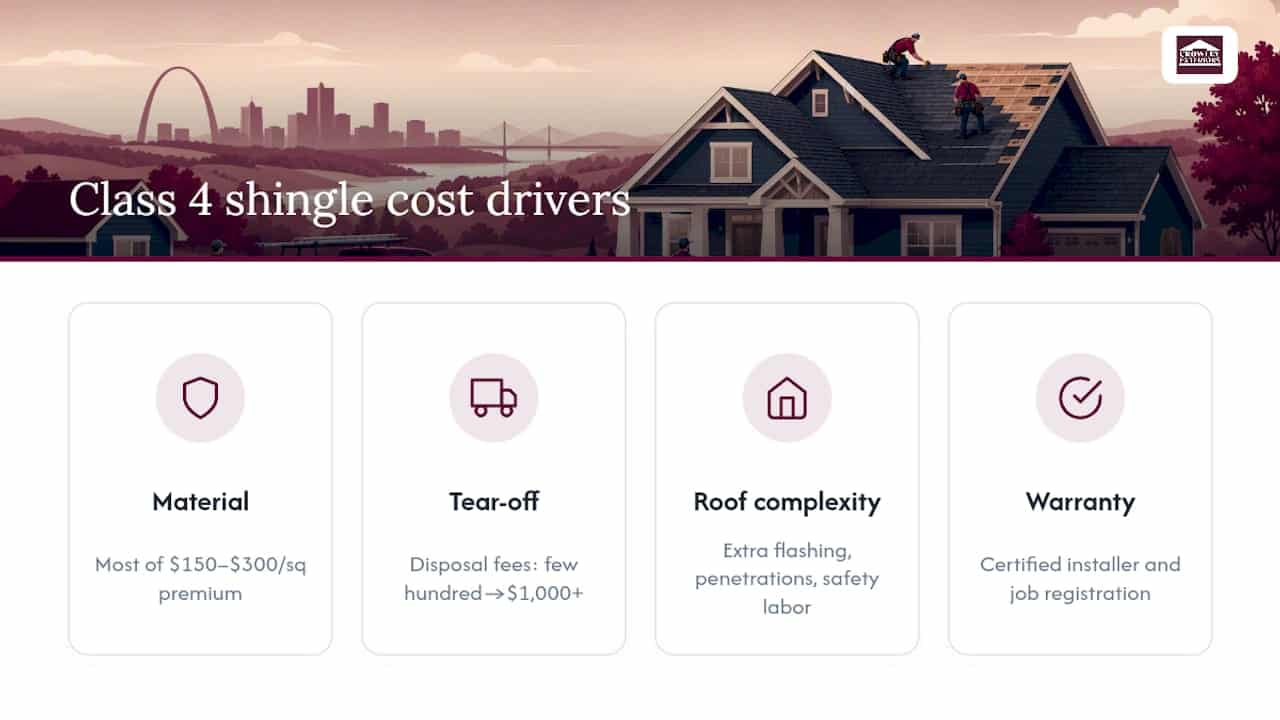
Material grade. Class 4 shingles earn their rating by passing UL 2218, a test that drops steel balls onto the shingle to simulate hail strikes and grades the material on whether it cracks. To pass at the top tier, manufacturers add heavier fiberglass matting, SBS or other polymer-modified asphalt for flexibility, and thicker granule surfacing. That extra material is where nearly all of the $150 to $300 per square premium lives.
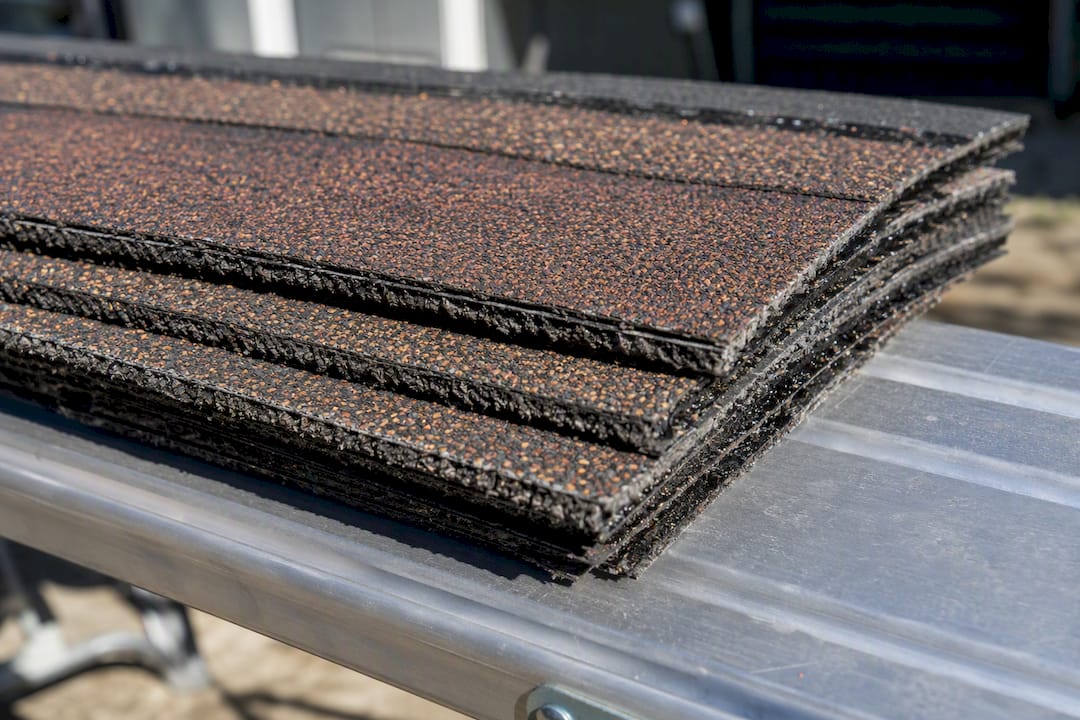
Roof complexity. A simple gable roof with two slopes takes far less time to flash and cut than a roof with dormers, multiple valleys, skylights, and chimneys. Every penetration needs custom flashing work, and steep pitches (anything above a 6/12) usually require safety equipment that slows the crew down. None of this is unique to Class 4 shingles, but it stacks on top of the material premium.
Tear-off vs. overlay. Installing over existing shingles saves money upfront but most installers recommend a full tear-off before a Class 4 install, both to check the deck for rot and to make sure the new shingles lie flat enough to perform as tested. Tear-off adds disposal fees, typically a few hundred to over a thousand dollars depending on how many layers come off and local dump rates.
Warranty registration. Manufacturer warranties on Class 4 products often require the installer to be a certified applicator and to register the job within a set window after completion. Skipping this step can void coverage even if the shingles themselves are installed correctly.
Pro Tip: Ask your contractor for the shingle’s manufacturer product data sheet before you sign anything. It lists the UL 2218 classification directly, and you’ll need that same document later if you’re filing for an insurance discount.
Do Impact-Resistant Shingles Actually Lower Your Insurance Bill?
Yes, in most states, but only on one slice of your policy. Insurers apply the discount to the wind/hail portion of your homeowners premium, not your total premium and not your deductible.
UL 2218 is the standard most carriers reference, and FM 4473 is a comparable test some insurers accept. Passing either at the Class 4 level is usually the minimum documentation an insurer wants before applying a credit, along with your contractor’s invoice showing the specific product installed.
Discounts on the wind/hail premium line typically range from 5% to 35% depending on your state and carrier, with the highest credits generally found in hail-heavy markets.
Here’s how that plays out by state, based on typical carrier practice:
- Texas, Oklahoma, and Colorado tend to offer some of the largest credits, often in the 20% to 35% range on the wind/hail line, because hail claims are frequent and expensive for insurers in these states.
- Kansas, Nebraska, and Missouri commonly see moderate credits, often in the 10% to 25% range, with some carriers running FORTIFIED-style programs that stack additional savings on top.
- Illinois and similar Midwest states with real but less severe hail exposure often land at the lower end, roughly 5% to 15%.
- Coastal and low-hail states frequently offer little to no wind/hail discount for impact resistance alone, since the risk driving the premium there is wind and flooding rather than hail.
To estimate your own savings, pull out your homeowners insurance declarations page and find the line item for wind/hail coverage, which is often broken out separately from your base premium in hail-prone states. Multiply that number by the discount percentage your carrier quotes. And that discount never touches your deductible: if your policy carries a 1% wind/hail deductible on a $300,000 home, you still owe $3,000 out of pocket on a claim, discount or not.
Is the Upfront Cost Worth It? Break-Even Math
The honest answer depends heavily on your ZIP code. Run the numbers both ways before you decide.
Annual savings of $20 or less means you’re still down roughly $4,000 to $4,400 after 20 years, since there’s little insurance credit and hail damage claims are rare to begin with. In that setup, the case for Class 4 rests more on durability and hail cracking resistance than on any real payback math.
- Every $100 increase in your annual wind/hail premium and discount percentage shortens your break-even timeline.
- A single avoided full roof replacement (often $10,000 to $20,000) after a major hailstorm can erase years of the upfront premium in one event.
- Carrier acceptance of the discount, and its exact percentage, varies by ZIP code, so confirm the figure with your own carrier rather than assuming a state average applies to you.
How to Estimate Your Own Class 4 Roofing Cost
Run this five-step process before you call a contractor, and you’ll be able to sanity-check any quote that lands in your inbox.
- Measure your roof and convert to squares. Get the total square footage from a prior roofing invoice, an appraisal, or a contractor’s satellite measurement, then divide by 100 to get squares.
- Pick your installed per-square baseline. Use $425 to $725 per square as your Class 4 range and $250 to $425 per square for standard, adjusting toward the high end if your roof has a steep pitch or multiple stories.
- Add complexity and tear-off costs. Tack on a few hundred to over a thousand dollars for tear-off and disposal, more if you’re removing multiple layers of old shingles.
- Calculate your insurance savings. Pull your wind/hail premium line from your declarations page and multiply by your carrier’s quoted discount percentage.
- Divide the premium by annual savings to get a rough break-even year, then compare that to how many years you plan to stay in the home.
Before you sign, request:
- The manufacturer’s product data sheet showing UL 2218 Class 4 rating
- An itemized invoice separating shingle material, tear-off, and labor
- Written confirmation of warranty registration completion
Getting Accurate Quotes and Spotting Red Flags
A trustworthy quote for Class 4 shingles reads like a parts list, not a single lump number. Ask for the exact shingle model, its UL 2218 or FM 4473 certification, tear-off cost broken out separately, permit fees, and the steps the contractor will take to register your warranty.
For insurance purposes, you’ll specifically need the product data sheet, the UL or FM certification document, and a contractor invoice that names the exact product model installed. Contractors who hand over this paperwork upfront make the insurance discount process far smoother than ones who leave you chasing it down after the job is done.
Watch for these warning signs:
- A contractor who showed up unsolicited after a storm and pressures you to sign the same day.
- Vague answers about which shingle model is being installed or refusal to provide certification paperwork.
- No mention of permits, especially in municipalities that require them for full tear-offs.
- Verbal promises about insurance discounts with nothing in writing to back them up.
Pro Tip: Call your insurance agent before you sign a contract, not after. Ask them directly what documentation they need to apply a wind/hail credit, so your contractor can build it into the paperwork from day one.
Crowley Exteriors’ Local Take on Class 4 Installs
We provide free inspections and no-obligation estimates on every Class 4 roofing project we quote in St. Charles County, along with the product data sheets and certification paperwork homeowners need for their insurance carrier. Every roof replacement we install carries a 25-year workmanship guarantee, built around what actually holds up against Missouri hail and wind.
— Mario
Get a Free Class 4 Roofing Estimate in St. Charles County
If you’ve run the math above and landed on “probably worth it,” the next move is getting a real number for your roof instead of a national average. Crowleyexteriors gives St. Charles County homeowners a free inspection and a no-obligation estimate that breaks out material, tear-off, and labor separately, so you can see exactly where the Class 4 premium is going before you commit to anything.
We supply the UL certification paperwork and product data sheets your insurance carrier will ask for, so you’re not chasing documents down after the job is finished. Our team has worked St. Charles County roofs for over 25 years, which means we know which hail patterns actually justify the upgrade and which roofs are fine with a standard architectural shingle. Every install carries a 25-year workmanship guarantee. Visit our roof replacement page to schedule your free inspection, or check out our full range of exterior services if you’re also weighing siding or gutter work alongside your roof.
Sources
- UL 2218
- Class 4 Impact-Resistant Shingles Guide 2026 – RoofVista
- Class 4 Impact Resistant Shingles: Worth It in 2026?
- Impact-Resistant Shingles Guide (ShinglesCalculator)