
Hire a licensed, insured local roofer who hands you an itemized written estimate and a written workmanship warranty, and don’t sign anything until three checks clear: license status verified with the state, a certificate of insurance confirmed directly with the insurer, and at least three written bids compared line by line. Skip any of these and you’re gambling with a five-figure project on your own roof.
TL;DR:
- Verify the license is active with the proper trade classification and has no disciplinary actions before hiring.
- Confirm insurance coverage directly with the insurer, ensuring at least $1 million in liability and workers’ compensation coverage.
- Obtain and compare at least three detailed, line-by-line itemized estimates for scope and costs from different contractors.
- Watch out for storm chasers with out-of-state plates, large upfront deposits, and reluctance to provide necessary documentation.
- Ensure the contractor pulls permits, provides written warranties, and keeps detailed records of all inspections and official documents.
Table of Contents
- What to Ask a Roofer Before You Hire
- How Do You Verify a Roofer’s License and Insurance?
- What Should Be on a Roofing Estimate?
- How Do You Spot a Roofing Scam?
- Do Roofers Need to Pull Permits?
- How Do You Choose Between Roofing Bids?
- What Does a Transparent Roofing Process Look Like?
- The Paperwork Homeowners Skip That Actually Protects Them
- Request a Free Roof Inspection From Crowleyexteriors
- Where to Verify a Roofer’s Credentials
- Sources
- FAQ
What to Ask a Roofer Before You Hire
Before you let anyone climb a ladder, get through this checklist on the phone with tips on contractor background checks. It takes ten minutes and eliminates most of the contractors you shouldn’t hire anyway.
Ask directly:
- What’s your license number and which state issued it?
- Who’s your general liability insurer, and what are your policy limits?
- How many years have you operated under this business name in this area?
- Who handles warranty callbacks if something leaks in year three?
Request in writing:
- A copy of the license ID, not just a verbal number
- A certificate of insurance (COI) sent to you directly from the insurance carrier, not a screenshot the contractor forwards
- A fully itemized estimate broken down by material, labor, and permit costs
- A sample contract you can read before the sales visit ends
Once you have those documents, verify them yourself. Run the license through your state’s contractor license lookup, call the insurer’s number (not one the contractor gives you) to confirm the COI is active, and check the manufacturer’s certified-installer locator if the contractor claims a brand partnership. This is the same due-diligence sequence ProsNook recommends starting with strong referral leads and a short pre-qualifying call before any inspection gets scheduled.
How Do You Verify a Roofer’s License and Insurance?
Verification isn’t optional paperwork. It’s the single biggest filter between a roofer who fixes your house and one who disappears after cashing your deposit.
- Check the license status. Pull up your state’s licensing board site and confirm the license is active, matches the correct trade classification, and has no pending disciplinary actions.
- Call the insurer, not the contractor. Ask the insurance company to confirm the COI is current and lists at least $1 million in general liability coverage. If the roofer has employees, workers’ compensation coverage matters just as much, since an uninsured injury on your property can become your liability.
- Ask about bonding. Some states require roofing bonds for larger jobs. A bond protects you if the contractor abandons work or fails to pay subcontractors.
- Check manufacturer certification. Credentials like GAF Master Elite, Owens Corning Platinum, or CertainTeed SELECT often unlock extended system warranties that a non-certified installer simply can’t offer you, no matter how good their workmanship is.
Pro Tip: Save the insurer’s confirmation email or reference number. If a claim dispute ever comes up, having proof you verified coverage before signing protects you as much as it protects the contractor.
Following The Roofing Brief’s guidance on credential checks, these four steps alone weed out a large share of unqualified operators before you ever discuss price.
What Should Be on a Roofing Estimate?
A real estimate reads like a parts list, not a price tag. If a bid just says “roof replacement, $14,500,” that’s not an estimate, that’s a guess dressed up as one.
Every itemized estimate should separate:
- Tear-off scope and disposal
- Decking repair allowance (what happens if rotted wood turns up underneath)
- Underlayment brand and type
- Shingle brand, model, and color
- Flashing and ventilation components
- Permit fees
- Labor and cleanup costs
Payment terms matter as much as the material list. A reasonable deposit is modest, tied to material delivery rather than the full job cost, with the final payment due only after you’ve signed off on completed work and passed inspection. Walk away from contracts that demand half or more upfront, use vague “or equivalent” material substitution clauses, include assignment-of-benefits language that hands your insurance claim to the contractor, or bury a binding arbitration clause pointing to a courthouse hundreds of miles away.
Comparing at least three written estimates line by line, rather than by total price alone, is how you catch a bid that looks cheap because it quietly skips flashing repair or uses a lower-grade underlayment. Our roof estimate checklist walks through exactly what each line should specify.
How Do You Spot a Roofing Scam?
Storm damage brings out two kinds of roofers: local companies who’ll still be around next year, and traveling crews who show up in a parking lot of unmarked trucks and vanish once the check clears.
Watch for:
- Out-of-state plates and door-to-door pitches right after a storm
- Demands for a large deposit before any work starts
- Reluctance to provide a license number, COI, or written estimate
- Any suggestion that skipping the permit will “save time”
Door-to-door post-storm sales pitches correlate heavily with future warranty problems, mainly because storm-chasers rarely stay local long enough to handle a callback. If you suspect you’re dealing with one, document everything, refuse to sign on the spot, and report the contractor to your state licensing board or attorney general’s office. A company with real local roots will have references you can actually drive by and see.
Do Roofers Need to Pull Permits?
Two warranties protect you after installation, and they cover completely different failures. The manufacturer’s warranty covers defective shingles or materials. The workmanship warranty covers installation mistakes, like flashing installed wrong or nails placed poorly, and that’s usually where real-world leaks come from.
Read workmanship warranty language for the specifics: what’s covered (flashing, valleys, penetrations), how long it runs, and what voids it. A properly written workmanship warranty spells out exclusions explicitly rather than hiding behind vague language.
Permits matter just as much. A permit and the resulting municipal inspection are the only third-party check confirming your new roof actually meets code. The contractor should pull the permit in their own name and build the fee into your estimate.
- Keep dated photos of the finished roof
- File the signed contract, COI, and final invoice together
- Save the permit and inspection approval
Pro Tip: Store this file digitally and physically. If you sell the house in five years, a buyer’s inspector will ask for exactly this paperwork, and having it ready can speed up your sale. Our guide on roof warranty coverage breaks down what to expect from each warranty type in more detail.
How Do You Choose Between Roofing Bids?
Three bids give you a real price range instead of a single number you’re guessing about. Discarding the highest and lowest bid and choosing from the middle based on scope clarity, warranty terms, and verified insurance tends to land you with the most reliable outcome.
- Reject the outlier bids. The cheapest often cuts corners you won’t see until it leaks; the most expensive doesn’t automatically mean better work.
- Compare the middle bids on non-price factors: warranty length, documented insurance, and how clearly the scope is written.
- Call two references from each remaining contractor and ask specifically about post-installation problems.
- Confirm the permit plan in writing before you sign anything.
| Final check | Why it matters |
|---|---|
| Call the insurer directly | Confirms the COI is real and active |
| Spot-check the license number | Catches expired or suspended licenses |
| Get the warranty in writing | Prevents verbal promises from disappearing later |
| Confirm who pulls the permit | Avoids code violations and resale headaches |
If any of these checks come back murky, delay the work and get a fourth bid rather than rushing into a signature. A roof replacement is not a purchase you want to redo in three years.
What Does a Transparent Roofing Process Look Like?
A local roofing, siding, and gutter company with significant experience offers free inspections and no-obligation estimates. The estimate follows the same itemized format this article recommends, and workmanship is backed by a long-term guarantee. Homeowners can use that same estimate structure and warranty language as a benchmark when comparing bids from any contractor.
The Paperwork Homeowners Skip That Actually Protects Them
Most advice on hiring a roofer focuses on personality: does the salesperson seem trustworthy, do they answer your calls, did the estimate feel thorough. That’s not wrong, but it’s backwards. The paperwork checks take ten minutes and catch problems a friendly sales pitch never will.
Here’s what gets overlooked. Homeowners verify a contractor’s reviews obsessively but rarely call the insurance company directly to confirm a COI is real. A contractor-forwarded PDF of an insurance certificate is trivially easy to fake or let lapse without you knowing. Calling the insurer takes five minutes and closes that gap completely.
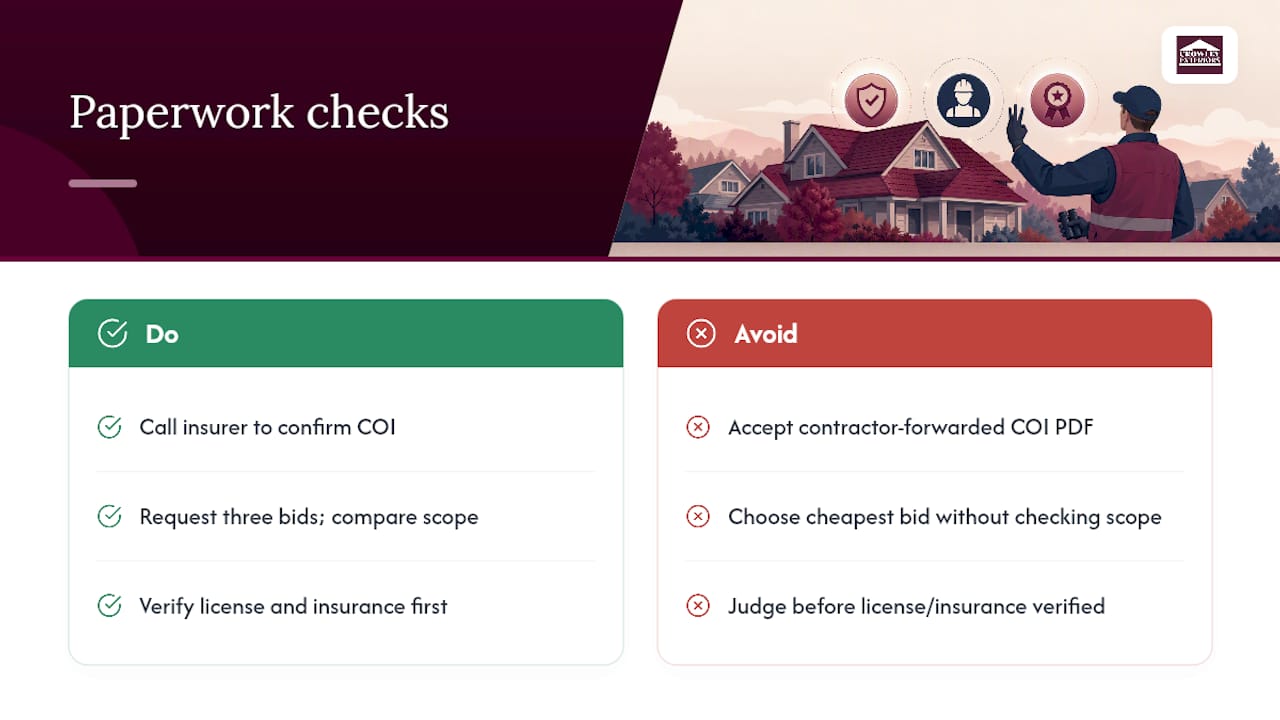
The other blind spot is treating price as the primary comparison point. Three bids exist to reveal the real local price range, not to find the cheapest number. If bid one is $11,000 and bid three is $19,000 for the same square footage, someone is either overcharging or planning to cut a corner you can’t see from the estimate. The scope, not the total, tells you which.
If you take one thing from this checklist, make it this: verify the license and insurance before you evaluate anything else about a contractor, including how much you like them.
— Mario
Request a Free Roof Inspection From Crowleyexteriors
If you’ve worked through this checklist and you’re ready to get a real quote, Crowleyexteriors offers a free inspection and a no-obligation estimate for homeowners in St. Charles County, built around the exact itemized format this article walks through: material, labor, permit fees, and warranty terms spelled out in writing, not promised verbally.
Roof replacement, repairs, and inspections are backed by a workmanship guarantee, with warranty language provided upfront for comparison. That means you’re not guessing whether a bid measures up to the standard this article describes; you can hold it side by side with Crowleyexteriors’ own estimate and see the difference in scope detail immediately. If a storm has already caused damage, some companies offer support to homeowners with their insurance claims. Ready to see what a transparent estimate looks like on your own roof? Request your free inspection and get a written, itemized quote with no pressure to sign on the spot.
Where to Verify a Roofer’s Credentials
Check your state’s contractor license lookup to confirm active status and disciplinary history, and use manufacturer certification locators (GAF, Owens Corning, CertainTeed) to confirm installer credentials tied to extended warranties. For material and installation standards, industry guidelines from groups like IBHS outline what durable, storm-resistant roofing construction should include.
Sources
- The Roofing Brief: How to choose a roofing contractor
- NRCA: 5-year workmanship warranty (roofing)
- ProsNook: How to hire a roofing contractor (7 checks)
- Roof Decision Guide: How to choose a roofing contractor
FAQ
How do you pick a good roofer?
Verify the license with your state, confirm insurance directly with the carrier, and collect at least three itemized written estimates before comparing warranty terms and local references.
Is $30,000 too much for a roof?
It depends heavily on roof size, material choice, and the scope of decking or structural repair needed; the way to know if a bid is fair is comparing multiple itemized estimates for the same scope rather than judging one number in isolation.
What is the 25% rule for roofing?
Definitions of this rule vary by region and building code, so ask your contractor directly how local code applies to repair versus full replacement on your specific roof rather than relying on a general rule of thumb.
What is a fair price for a new roof?
A fair price is one that falls within the middle range of at least three itemized bids for identical scope, material brand, and labor terms, since outlier bids on either end often signal missing scope or inflated margin.
What questions should I ask a roofing contractor?
Ask for the license number and issuing state, insurer name and policy limits, years operating locally, and who handles warranty callbacks, then verify every answer independently before signing a contract.
Recommended
- What Should Be On Your Roof Estimate Checklist?
- Roof Leak Emergency: What Homeowners Must Do Now
- Roof Financing Options: Your Complete 2026 Guide
- When To Replace Your Roof: Signs, Timelines, And Costs
This article was prepared with AI assistance for general information. For recommendations specific to your property, contact Crowley Exteriors. Call or text us at 314-839-3800.